regional node
node: tallinntier: 1coverage: strategicstatus: regional dispatch
Context: {mode=city-node} {node=tallinn} {region=europe} {coverage=strategic} {dispatch=regional_dispatch}
Smart hands · remote hands · Tallinn

Datacenter smart hands in Tallinn, Estonia

TYTEC coordinates precise, evidence-led datacenter field work across Tallinn and the surrounding Harju County market. From a guided port check to a staged rack deployment, every request begins with the exact facility, access sponsor, work window, method of procedure, and close-out standard.

Europe Estonia Tier 1 strategic regional dispatch
Tallinn operating context

Estonia's digital capital and the northern Baltic gateway

City-specific context for infrastructure teams planning smart hands, remote hands, rack work, and controlled field changes.

Tallinn combines a large purpose-built campus at Hüüru with carrier-neutral, cloud-connected, and central-city facilities. That range supports enterprise colocation, interconnection, business continuity, and higher-density deployments without treating every site as operationally identical.

The city sits naturally in regional plans spanning Helsinki, Stockholm, and Riga. Ferry, air, and terrestrial network links make Tallinn a practical northern entry point, while local site rules still determine whether a task needs pre-registration, an escort, a loading plan, or operator approval.

TYTEC does not claim to operate the facilities listed here. We use verified facility references to remove ambiguity, prepare the right field workflow, and return engineering-grade evidence to the remote owner of the work.

Operating time
EET / EEST
Regional role
Northern Baltic gateway
Published references
3 Tallinn-area facilities
Natural routes
Helsinki · Stockholm · Riga
Tier 1 operating stance

Operational context for Tallinn

Tallinn is Estonia's principal datacenter market and the northern Baltic gateway between Helsinki, Stockholm, and the wider Baltic network corridor.

Request focus

What strong requests include

Tallinn requests should identify the exact facility and access sponsor, then state whether the work involves carrier-neutral interconnection, enterprise colocation, or a smaller central-city environment.

Execution fit

Where this node is strongest

  • Purpose-built capacity at Greenergy Data Centers supports larger colocation, high-density, and built-to-suite requirements.
  • DataHOUSE@Tallinn and WaveCom add carrier-neutral, cloud, and central-city facility options.
  • The node is well placed for multi-city work spanning Helsinki, Riga, and Stockholm.
Datacenter context

Datacenters in and around Tallinn

Relevant colocation and interconnection references for Tallinn include Greenergy Data Centers Tallinn DC-1, CITIC Telecom CPC DataHOUSE@Tallinn, WaveCom Tallinn Data Center. This is contextual market information for routing and engagement, not a claim that TYTEC operates those sites.

Facility reference layer

3 mapped facilities across 3 operators

  • 0 TYTEC facility pages available
  • 3 external facility sources linked
  • 0 references currently resolved through city-node context
Routing use

How these references are used

  • Validate facility naming before dispatch and reduce site ambiguity
  • Clarify whether the operator has a TYTEC facility page, an external source, or only city-level context
  • Support better request scoping for campus, room, cage, and rack handoff
Datacenter reference

Greenergy Data Centers Tallinn DC-1

Greenergy's Hüüru campus offers carrier- and cloud-neutral colocation with renewable energy, dual-feed power, up to 20 kW per cabinet, a target PUE below 1.2, and 24/7 security and NOC coverage.

Operator: Greenergy Data Centers

Reference path: External facility source

Alajaama tee 1, 76911 Hüüru, Harju County, Estonia

Open external facility source

Datacenter reference

CITIC Telecom CPC DataHOUSE@Tallinn

CITIC Telecom CPC describes a 600 m² carrier-neutral facility about 15 minutes from Tallinn Airport, with local technical staff, redundant critical systems, and connectivity into its international backbone.

Operator: CITIC Telecom CPC

Reference path: External facility source

Tallinn, Estonia — approximately 15 minutes from Tallinn Airport

Open external facility source

Datacenter reference

WaveCom Tallinn Data Center

WaveCom's Endla 16 facility is a central-city colocation and cloud location built around redundant power, cooling, connectivity, biometric security, and controlled customer access.

Operator: WaveCom

Reference path: External facility source

Endla 16, 10142 Tallinn, Estonia

Open external facility source

Regional identity

Baltic reach, Nordic coordination

Tallinn is one of TYTEC's three published Baltic operating nodes, connected to Tallinn, Riga, Vilnius, Helsinki, Stockholm, and Warsaw planning routes.

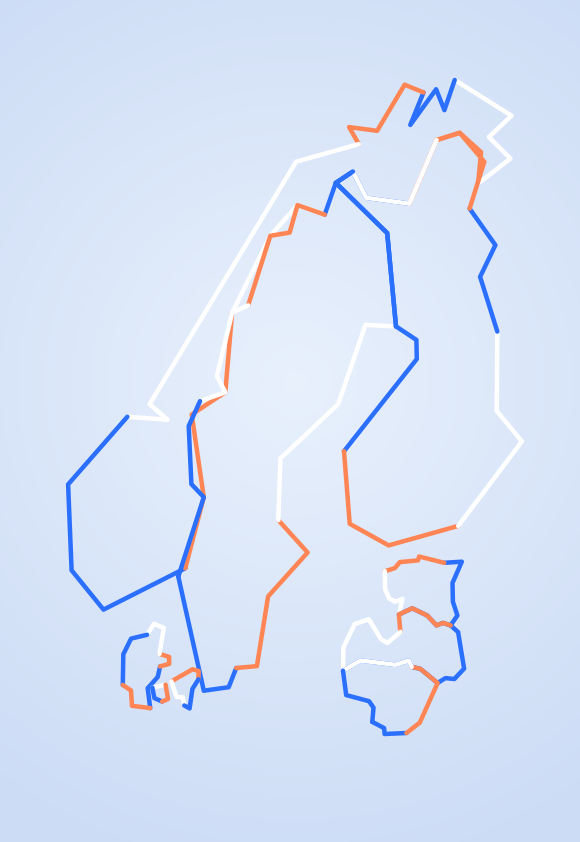
TYTEC Nordic and Baltic operating region Stylized map of Norway, Sweden, Finland, Denmark, Estonia, Latvia, and Lithuania.
Services

Tallinn smart hands and remote hands services

These are the strongest Tallinn use cases. Every task remains subject to scope, facility rules, access, and technician confirmation.

  • Guided smart hands for hardware, LEDs, cabling, and console observations
  • Remote hands with timestamped photos, serial capture, and written close-out
  • Fiber and copper patching after port, media, and authorization checks
  • Rack-and-stack work for staged installs, swaps, and migration runbooks
  • Inventory, labeling, and decommission preparation with chain-of-custody notes
  • Multi-city coordination for Tallinn, Helsinki, Stockholm, and Riga programs
Coverage model

How this node is operated

Coverage type, team status, and language support are shown in the node console and hero. This section defines what the operating model means in practice.

Tallinn is a strategic TYTEC market coordinated through regional dispatch. TYTEC validates the site, access sponsor, timing, runbook, and evidence standard before confirming the local execution path.

Required inputs

What to send for Tallinn dispatch

Use this Tallinn intake list to prevent facility ambiguity and reduce avoidable dispatch delay.

  • Exact Tallinn-area facility name and full address, including Hüüru versus central-city location
  • Room, hall, cage, rack, RU position, and both ends of every affected connection
  • Named access sponsor, visitor-registration status, escort need, and identity requirements
  • Local EET/EEST work window, maintenance risk, and explicit rollback decision point
  • Approved MOP or ordered task list with remote engineering bridge details
  • Required photos, labels, serial numbers, console output, and close-out recipient
After-hours

After-hours support in Tallinn

After-hours feasibility depends on the named facility, approved access, technician availability, and an authorized remote decision path.

For Tallinn work outside the normal window, provide the facility's pre-registration deadline, named access sponsor, escort status, local EET/EEST time, emergency contact, and a rollback decision point.

Tallinn FAQ

Datacenter smart hands questions

Direct answers for teams preparing a Tallinn field-support request.

Can TYTEC provide smart hands in Tallinn?

Yes, subject to scope, technician availability, facility approval, and access confirmation. Send the precise site, rack, task, local work window, and evidence requirements so TYTEC can confirm the delivery path.

Which Tallinn datacenters are covered on this page?

The published routing references are Greenergy Tallinn DC-1 in Hüüru, CITIC Telecom CPC DataHOUSE@Tallinn, and WaveCom's Endla facility. TYTEC can also assess other named Tallinn-area sites case by case.

What should a Tallinn remote-hands request include?

Include the access sponsor, room and rack identity, ordered steps or MOP, affected ports or assets, EET/EEST timing, rollback point, remote escalation bridge, and required close-out evidence.

Example request

Copy-paste request template

Use this format when opening a formal request. It makes the TYTEC operating model explicit and reduces handoff friction.

Subject: Tallinn | Remote hands | <site> | <rack> | <date/time local>
City node: Tallinn
Site / facility: <facility name> (<address>)
Location: <room/hall/cage/rack>
Task: <one sentence>
Steps / MOP: <link or attached>
Access: <badge/escort/loading/security>
Evidence needed: <photos/serials/labels/console outputs>
Escalation: <name + phone + email>
Close-out format: <single summary + evidence bundle>
Evidence standards

Tallinn close-out evidence

Evidence is part of the Tallinn deliverable and should be approved before physical work begins.

  • Photograph the Tallinn facility handoff point only where site policy permits
  • Capture rack, RU, asset tag, serial number, and cable labels before any change
  • Record both ends of every approved patch and note the exact port identifiers
  • Timestamp observed LEDs or console states and separate facts from diagnosis
  • Return a concise completion note, exceptions, rollback status, and evidence bundle
Regional node console

Tallinn node ready

Use the command router for a short operational readout, then continue into the local node profile below.

NODE: TALLINN
REGION: EUROPE
FACILITY MAP: 3 VERIFIED FACILITY REFERENCES
COVERAGE: STRATEGIC
DISPATCH: REGIONAL DISPATCH
LANGUAGES: ENGLISH / ESTONIAN
READY: LOCAL CAPABILITY PROFILE ONLINE
tytec.ai/cities> load-node tallinn --tier 1 --coverage strategic
Dispatch path

Tallinn requests are scoped through TYTEC regional dispatch, with site access and the local execution path confirmed before a technician is committed.

Regional context

Estonia's principal datacenter market and the northern Baltic gateway, with purpose-built capacity, carrier-neutral interconnection, and central-city cloud infrastructure.

Command router

Tallinn command surface

Type a command or use the chips below to load node status, geo, service, facility, and dispatch views for Tallinn.

Formal intake

How to send the request

Send the formal request via TYTEC.se/contact, reference the Tallinn node, and include the structured request template above.

Related cities

Related nodes

Use related nodes when a runbook spans multiple metros or when the nearest viable execution path sits outside a single city.